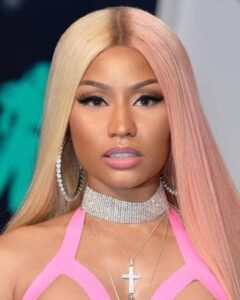
AMERICAN RAPPER NICKI MINAJ URGES NIGERIAN CELEBRITIES TO SPEAK OUT AGAINST PERSECUTION OF CHRISTIANS
Her Appeal Reignites Debate Over Religious Freedom, Insecurity And The Political Interpretation Of Violence That Has Devastated Communities Across Nigeria.
From deadly attacks on rural communities to kidnappings, burned churches and mass displacement, Nigeria’s security crisis has drawn renewed international attention. While supporters welcome Nicki Minaj’s intervention, critics warn against reducing the country’s complex violence to a single religious narrative.
American rapper Nicki Minaj has called on Nigerian celebrities, entertainers and social media influencers to speak out against what she described as the brutal treatment of Christians in Nigeria, arguing that the suffering of affected communities deserves greater international attention. She made the appeal on Saturday, October 10, 2026, during an X Takeover event at Tesla’s Giga Texas facility in Austin, Texas, United States. Explaining her personal connection to Nigeria, Minaj said, “For Nigeria personally, my pastor is from Nigeria, so I have a link to Nigeria because of him. And of course, I have a lot of Nigerian barbs, but what I started seeing was the brutality with which Christians are being treated there just for being Christian.” She questioned the limited public attention given to the issue, saying, “And I thought, why isn’t anyone making a big deal out of this, you know? And sometimes when things aren’t cool to talk about, people don’t talk about it.” She then called on more public figures to join the campaign, adding, “So right now, actually, I’m hoping that more celebrities or people, influencers, I’m hoping that they come aboard the train to start speaking out about what’s happening to Christians in Nigeria. And I look forward to doing more to help in that way, in that cause.” Her remarks, reported by Nigerian news outlets on October 11 and 12, came almost 11 months after she addressed religious violence in Nigeria at a United States Mission to the United Nations event in New York on November 18, 2025.
The appeal has placed the responsibility of public figures at the centre of a difficult national conversation. Minaj believes celebrities can help draw attention to attacks that might otherwise receive limited international coverage. But her intervention has also raised questions about how the crisis should be described, whether its different causes are being adequately explained and what practical steps should follow the growing publicity
HOW THE CONTROVERSY STARTED.
Minaj’s latest remarks did not emerge in isolation. They followed an international debate that intensified in October and November 2025, when US President Donald Trump publicly alleged that Christians in Nigeria faced severe persecution and threatened possible military action over the killings.
On November 1, 2025, Minaj expressed support for religious freedom in a post on X, writing, “No group should ever be persecuted for practicing their religion.” She also expressed gratitude for living in a country where people could worship freely. Her position attracted praise from people concerned about attacks on Christians, while others criticised her for endorsing a political narrative they considered incomplete.
The controversy grew on November 18, 2025, when Minaj delivered an address at the United States Mission to the United Nations in New York during an event titled Combating Religious Violence and the Killing of Christians in Nigeria.
In her speech, she said: “In Nigeria, Christians are being targeted, driven from their homes, and killed. Churches have been burned, families have been torn apart, and entire communities live in fear constantly, simply because of how they pray.”
She argued that protecting Christians should not be treated as an attempt to divide people along religious lines. Rather, she presented it as a defence of a fundamental human right.
However, the event was politically sensitive because it aligned with the Trump administration’s campaign to draw attention to alleged Christian persecution in Nigeria. Nigeria’s government rejected the suggestion that the country was pursuing a state-backed campaign against Christians, maintaining that the country’s security crisis affects citizens of different religious backgrounds.
This disagreement helped transform Minaj’s intervention from a celebrity statement about religious freedom into a wider debate involving Nigerian sovereignty, American foreign policy, religious identity and the causes of insecurity.
A CRISIS THAT GOES BEYOND PUBLIC STATEMENTS
Nigeria’s insecurity is not a new problem, and it cannot be explained by one incident or one group of perpetrators. For years, communities have suffered attacks by Islamist insurgents, armed bandits, kidnappers and other violent groups. In some areas, communal conflicts involving farmers and pastoralists have also contributed to deadly violence.
Christians have been deliberately targeted in particular attacks, including assaults on churches, religious leaders and predominantly Christian settlements. Such violence has resulted in deaths, abductions, destroyed homes and mass displacement.
The US Department of State’s 2023 International Religious Freedom Report, for example, documented coordinated attacks on more than 17 villages in Plateau State on December 24, 2023, in which more than 150 people were killed, most of them Christians. The report also recorded attacks affecting predominantly Christian communities elsewhere in the country.
At the same time, armed groups have killed and abducted Muslim civilians, attacked mosques and terrorised communities regardless of faith. The wider security crisis includes ideological insurgency, criminal kidnapping, competition over land and resources, communal tensions and failures of protection and accountability.
This complexity does not make the persecution of Christians less serious. Rather, it underlines the need to identify the perpetrators and motives behind individual attacks instead of assuming that every incident has the same explanation.
NICKI MINAJ: THE ARTIST BEHIND THE CAMPAIGN
Born Onika Tanya Maraj on December 8, 1982, in Saint James, Trinidad and Tobago, Nicki Minaj became one of the most recognisable female rappers of her generation after building a career in the United States.
She gained international prominence through her distinctive delivery, changing vocal styles, colourful image and a series of successful songs, including Super Bass, Starships and Moment 4 Life. Her debut studio album, Pink Friday, reached No. 1 on the Billboard 200.
Her influence extends beyond music. Minaj has cultivated a large international fanbase known as the Barbz, many of whom follow her statements and activities across social media.
SUPPORTERS WELCOME HER DECISION TO SPEAK OUT
Minaj’s intervention has received support from people who believe that attacks on Christians deserve more international attention. Reactions reported after her November 2025 United Nations speech included expressions of gratitude, praise for her willingness to speak publicly and calls for Nigerian celebrities to follow her example.
Several themes emerged among supporters are:
First, some welcomed the attention given to Christian victims. They argued that reports of killings, abductions and attacks on churches should not be overlooked simply because the issue has become politically controversial.
Second, some praised her defence of religious freedom. They viewed her central message that nobody should be persecuted for practising a religion as a universal principle that deserves support regardless of a person’s faith.
Third, others called on Nigerian celebrities to become more vocal. Supporters argued that entertainers and influencers can use their audiences to amplify credible reporting, demand accountability and raise assistance for displaced families.
CRITICS QUESTION THE POLITICAL FRAMING OF HER MESSAGE
Not everyone welcomed Minaj’s intervention. Some Nigerians and international commentators criticised the political context of her November 2025 speech and argued that the country’s security crisis was being presented too narrowly.
Reactions reported by international media included calls for Minaj to avoid taking positions on Nigerian politics without a deeper understanding of the country’s history and security challenges.
One concern was that her appearance at a US-organised diplomatic event could reinforce a political narrative that treats Nigeria’s violence primarily as an organised campaign against Christians.
One concern was that her appearance at a US-organised diplomatic event could reinforce a political narrative that treats Nigeria’s violence primarily as an organised campaign against Christians.
Critics argued that the crisis also involves attacks on Muslims, criminal kidnapping, communal disputes and violence driven by economic and territorial interests. They warned that ignoring these factors could distort public understanding of the situation.
Others questioned the use of the term genocide, arguing that such a serious classification requires evidence about the perpetrators’ intentions, the pattern of attacks and the groups being targeted. Their objection was not necessarily that Christians had suffered no persecution, but that the scale and character of the violence needed careful examination.
NEUTRAL OBSERVERS CALL FOR EVIDENCE AND PRACTICAL SOLUTIONS
A more cautious position has emerged among observers who believe that Minaj’s intervention should be judged by the attention it brings to the victims, while the facts about individual attacks are established independently.
For these observers, the starting point is straightforward: every civilian has the right to life, safety and freedom of worship.
They argue that attacks on Christians should be documented and investigated, just as attacks on Muslims and other civilians should be. Recognising one group’s suffering does not require denying another’s.
They also believe that celebrity advocacy can be useful when it encourages audiences to seek reliable information, listen to survivors and support credible humanitarian efforts. But they warn against allowing a complex security crisis to become a competition between religious communities.
Furthermore, American rapper Nicki Minaj’s appeal for Nigerian celebrities and influencers to speak out against the persecution of Christians has renewed an important conversation about religious freedom, insecurity and the responsibility of public figures.
Her latest remarks on October 10, 2026, followed her November 18, 2025, address at the United Nations, showing that her interest in the issue has continued beyond a single public appearance.
The reactions to her intervention reveal different concerns. Supporters welcome the international attention she has brought to Christian communities facing violence. Critics question the political framing of her message and warn against overlooking the wider security crisis. Others believe the most useful response is one grounded in evidence, compassion and practical solutions.
Like Our Story ? Donate to Support Us, Click Here
You want to share a story with us? Do you want to advertise with us? Do you need publicity/live coverage for product, service, or event? Contact us on WhatsApp +16477721660 or email Adebaconnector@gmail.com